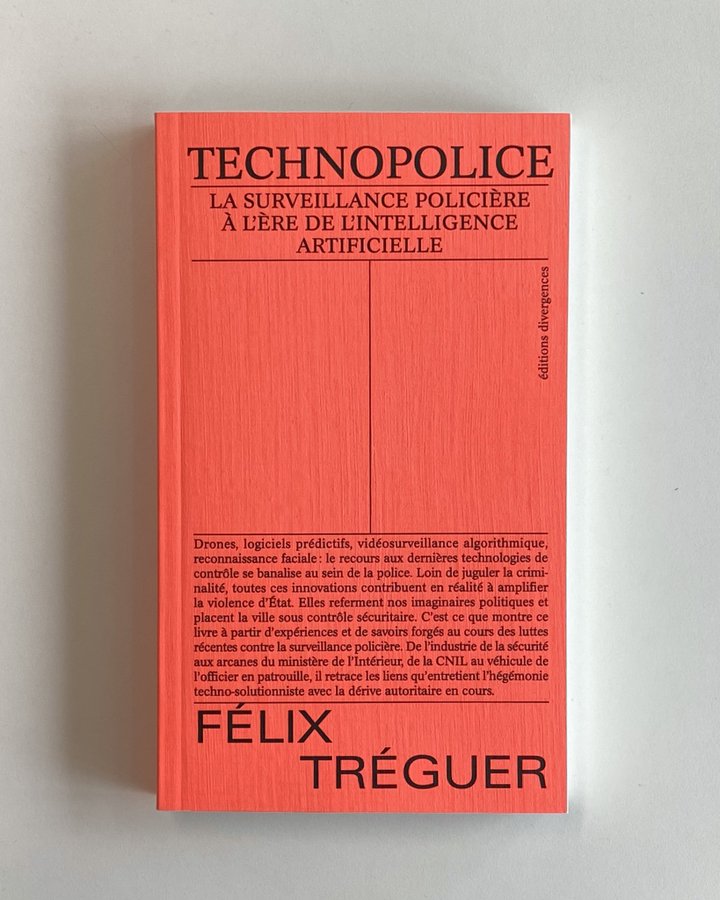
My new book "Technopolice" is out!
The book Technopolice (in French only) is out! Get it from Éditions Divergences.
Here is the summary:
“Drones, predictive software, algorithmic video-surveillance, facial recognition: the use of the latest technologies of control is becoming commonplace within the police. Far from curbing crime, all these innovations are actually amplifying state violence. They place the city under siege and close up our political imaginations. This is what this book shows by drawing on experiences and knowledge forged during recent struggles against police surveillance. From the security industry to the Ministry of the Interior, from the CNIL to the officer’s vehicle on patrol, it connects the dots between the growing techno-solutionist hegemony contributed and the current authoritarian drift.”
Reviews
“[These are] investigative fables that express, through the literary necessity of inventing new ways of writing within the most academic discourse, the urgent need to take action in this world in disarray. [These] reports that tell of the horrific futures being predicted very publicly: this is not excessive criticism or ‘politics,’ but simply an act of presence and testimony."
The Display of Oppression, Pierre Tenne, En attendant Nadeau, December 31, 2024
“While the strengths of F. Tréguer’s book lie in its ability to systematize an in-depth analysis of surveillance in relation to technological advances, it stands out for its intimate approach to police experience, which is rare in sociological research given the difficulties in accessing law enforcement agencies.”
Reading note, Camila Pérez Lagos, Questions de communication, November 2025
“The [author’s] argument, grounded in activism, is assumed if not claimed. It takes nothing away from the demonstration, which is relentless and nourished by abundant sources (241 references to articles, reports, and books, or more than one per page of text). Wary of ‘ready-made militant thinking,’ the author also takes fascinating detours through history and makes skillful use of the technique of reportage. His work, in both tone and form, is thus in the best tradition of Anglo-Saxon investigative journalism: well-documented and precise on its main subject, it does not shy away from forays into the disciplines of sociology, philosophy, and personal experience.
“Technopolice”: the acceleration of the tempo of algorithms, to the detriment of civil liberties, Antoine Albertini, Le Monde, October 15, 2024
“Drawing on this experience, the reflections presented in Technopolice give way to personal accounts while illuminating them with theoretical insights. The result navigates between journalistic investigation and in-depth analysis of the discourse and struggles surrounding police technologies.”
Panopticon for all, Julien Le Mauff, Books And Ideas, February 19, 2026.
“The author articulates the methods of three disciplines: sociology, political science, and ethnology. He collects data through meetings with field workers and decision-makers (more or less formal interviews), consultation of documents produced by public or private organizations (published or unpublished), and participant observation of concrete situations (trade shows, police activities), mainly in France, but also in the United States for part of the study. The sequence of their presentation in the general discussion makes for a fluid and enjoyable read; it is all the more scientifically convincing, despite the unsystematic and undiscussed nature of the method. The book thus sheds major light on the (dis)continuities between concrete practices and political or industrial projects.
Book review, Philip Milburn, Champ pénal, October 21, 2025